“If you’re not willing to risk the usual, you will have to settle for the ordinary…” Jim Rohn
I don’t think anyone properly prepares you for the very specific, slightly unhinged anxiety that comes with leaving a perfectly stable, perfectly respectable, perfectly predictable PAYE job after twenty years and deciding, quite calmly, quite rationally, after what was probably an awful day at the office, that you’re now going to rely entirely on yourself to generate money, momentum, purpose, and, ideally, a sense that you haven’t completely lost the plot.
Because on paper, it sounds brilliant.
As a mum, solo parent and rock to two smaller versions of myself, I knew they needed me more than the world of 9-5 was allowing.
Cut to freedom, flexibility, control over my time and the ability to choose the work I want to do, the people I want to do it with, and the life I want to build around it, which, after two decades of meetings about meetings and objectives that often felt two steps removed from anything real, felt not just appealing but necessary.
And in reality, it is all of those things.

It’s just also… this other thing.
This low-level, ever-present, occasionally quite loud hum of “is this actually going to work?” that seems to live somewhere between your chest and your inbox, and tends to get particularly chatty at 3am, when your brain decides it would be a great time to revisit every proposal you’ve sent in the last three months and assess, in forensic detail, whether you came across as insightful and experienced or like someone who has absolutely no idea what they’re doing but is very good at using words like “strategic.”
What’s slightly maddening is that none of this anxiety feels particularly dramatic. There are no big, cinematic breakdowns, in fact, it’s much more British than that.
It’s refreshing your emails with the quiet optimism of someone who knows there’s probably nothing new there but checks anyway, just in case today is the day everything suddenly clicks into place.
It’s mentally recalculating your pipeline while you’re doing something completely unrelated, like making a ourself a hot drink or pretending to listen to someone at a school gate, and realising that if two things slip and one thing delays, you may need to have a conversation with yourself about “diversifying revenue streams,” which is a phrase you never thought you’d apply quite so personally.
It’s sending something off, something you’ve thought about properly, something you know is good, and then immediately entering into a spiral where you’re absolutely certain it’s either the best piece of work you’ve ever done or a catastrophic misread of the brief, with absolutely no middle ground.
And then, just to keep things interesting, there are the quiet periods. The ones no one really warns you about or you did not consider…

The days where nothing urgent is happening, nothing is on fire, and no one is chasing you, which, after years of being busy to the point of mild resentment, should feel like a reward, but instead feels deeply suspicious, as though you’ve somehow been forgotten by the entire professional world and it’s only a matter of time before someone realises and corrects the error.
And here’s the thing I keep coming back to, usually after I’ve had a word with myself and maybe gone for a walk to re-establish a baseline level of sanity: This is insanely normal. Not in a “everyone feels like this all the time, so just get on with it” way, but in a “you have fundamentally changed the rules of how your life works and your brain is trying to catch up” way.
I mean, for twenty years, the structure was doing a lot of heavy lifting. Money arrived at the same time every month, regardless of whether you’d had a brilliant week or a slightly questionable one where you spent too long in PowerPoint and not enough time thinking. Your role, your title, your organisation, all of it quietly reinforced your value without you having to constantly prove it from scratch.
There were other people. Other brains. Other safety nets. And then one day, there aren’t. Or rather, there are, but they’re you. You are the strategy and the delivery and the new business and the client service and the occasional IT support when something inexplicably stops working five minutes before a call.
Which is empowering, obviously, and also… a lot.

There’s the part I didn’t fully clock until I was in it: As a marketer, I’ve spent my entire career very happily sitting behind other people, helping them find their voice, shape their story, build their reputation, and, if we’re being honest, make them look very good in rooms they might not have got into without a bit of careful narrative support. I know how to build brands, create belief and I know how to position people so they feel credible, differentiated, and worth paying attention to.
And yet, the moment I have to do that for myself, it’s as though all of that knowledge quietly packs up its things and leaves the room.
Suddenly, every line I write about my own business feels either slightly overblown or wildly underwhelming. I’ll look at my own website and think, “this is either incredibly clear and compelling, or complete nonsense that no one will understand,” and I genuinely cannot tell which it is.
I’ll send out a proposal and then spend a solid hour wondering if I’ve accidentally mis-sold myself, over-promised, under-sold, used the wrong tone, or fundamentally misunderstood my own value, which is a fascinating spiral to be in when you are, in theory, the expert.
Don’t even get me started on the imposter syndrome – honestly, it’s almost impressive! The way it can sit there, calmly ignoring actual evidence.
Invoices being paid? Irrelevant.
Clients coming back? Coincidence.
Testimonials saying very nice, very real things about the work? Clearly they’re just being polite.
It’s like your brain has decided that none of the tangible proof counts, because the real question it’s trying to answer is much more uncomfortable, which is: am I actually as good as I think I am? And that question doesn’t have a neat, immediate answer. It builds slowly, over time, through doing the work, through seeing the impact, through having people trust you enough to bring you into their business, their thinking, and their challenges.

But in the early stages, and, if I’m honest, not just the early stages, it can feel like you’re constantly toggling between quiet confidence and absolute disbelief that anyone is taking you seriously. – which is wild!
In November last year, I removed the brand behind me, took away the company name, the team, and the structure that used to signal credibility before I even opened my mouth, and now it’s just my name. My thinking, my words, my work. So it feels very exposing…
So of course it feels a bit like I’m making it up as I go along, even when I absolutely am not, but the more people I speak to, the more I realise that this feeling isn’t a glitch.
It’s the system.
It’s what happens when you trade predictability for possibility, when you remove the external structures that used to contain the risk and bring it much closer to home, where it sits on your shoulders and occasionally whispers unhelpful things like, “you do realise this is all entirely up to you now, don’t you?”
And yet, slightly annoyingly, it’s also where the good stuff lives, because underneath the anxiety is something much more interesting.
It’s care, for a start. The kind that’s hard to manufacture when you’re working on something that ultimately belongs to someone else.
It’s ownership. The ability to make decisions that actually matter and see the impact of them, in real time, in your own work, in your own business.
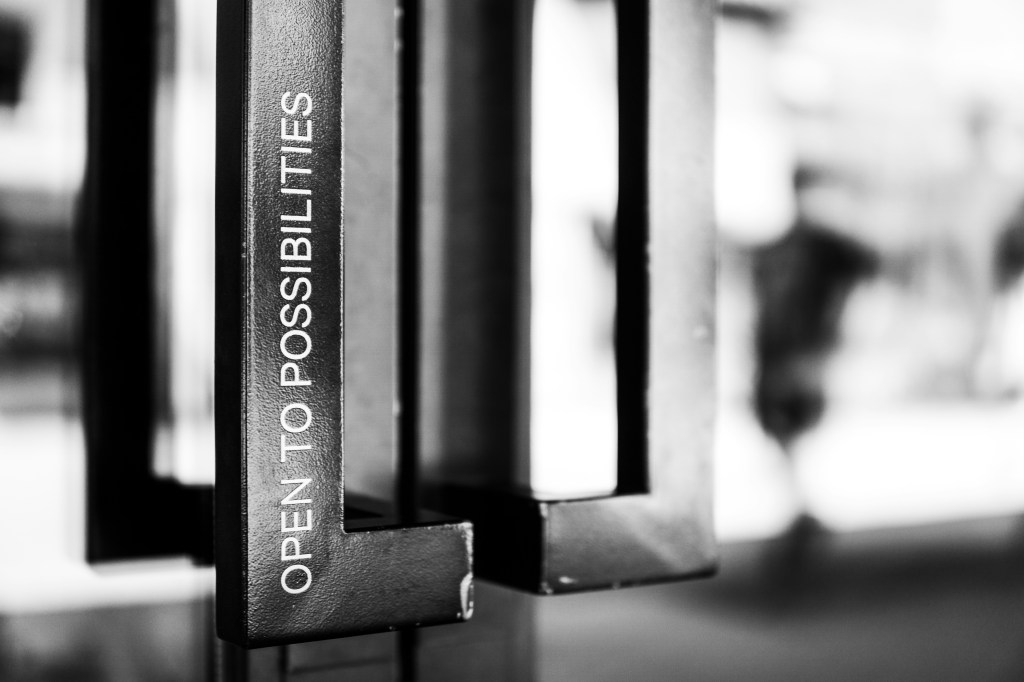
It’s the slow, slightly uneven process of building something that reflects how you think and what you believe, rather than what fits neatly into someone else’s framework, and over time, and I say this as someone still very much in the “over time” part, you start to notice small shifts.
You begin to recognise your own patterns, the dips that come after big projects, the wobble that follows sending something important, the unnecessary comparison with people who look, from the outside, like they have everything perfectly under control (they don’t, by the way, they’re just better at curating it).
You start to build your own structure, not as rigid as the one you left behind, but more intentional, more yours.
You learn that quiet doesn’t always mean something’s wrong, sometimes it just means there’s space before the next thing arrives, which it usually does, often when you’ve just convinced yourself it won’t.
You get better at trusting your own judgement, which is both liberating and slightly terrifying, because there’s no one else to blame when you get it wrong, but also no one else to dilute it when you get it right.
And perhaps most importantly, you begin to understand that feeling anxious doesn’t mean you’re failing, it means you’re doing something that matters to you, something that has stakes, something that hasn’t been smoothed out by process and precedent and years of someone else holding the edges.
So if you’re in it, if you’ve taken the leap, or you’re standing on the edge of it, weighing up whether the freedom is worth the occasional 3am existential audit of your entire career, Just know this:
The overthinking, the second-guessing, the strange combination of excitement and mild panic, the way your brain can move from “this is the best decision I’ve ever made” to “should I get a job in something very stable, like accounting?” in the space of a single afternoon…The feeling that you are somehow both highly experienced and completely winging it or the voice that tells you your work isn’t good enough, even as people are quite literally paying you for it… All of it is part of the deal.
Insanely uncomfortable, occasionally hilarious, if you catch it at the right moment, deeply exposing, and, whether anyone admits it or not, insanely normal.

